
Technology,
Digital Transformation & AI
Digital transformation is often presented as the natural path to modernizing organizations. However, the evidence accumulated over decades shows a different reality: a large proportion of IT projects fail to generate real business impact or integrate effectively into operations, especially when undertaken without clear governance or the digital capabilities required for their execution.
When an organization fails to build its digital capabilities, strategy simply doesn’t get executed — and the cost isn’t limited to the project or the budget: it delays execution, weakens leadership, and leaves the organization less prepared for change.
Services

Digital Transformation
Enabling the organization —governance, capabilities, and technology platform— so that the defined strategy can actually be executed in day-to-day operations.

Digital Business Models
Designing and evolving value propositions and commercial models that leverage technology to create new sources of growth.
AI at Scale
Adopting AI integrated into core business processes, with a focus on measurable operational impact rather than isolated pilot projects.

Innovation and Agility
Structures and ways of working that allow the organization to adapt quickly to changes in the environment and the market.

Technology Governance
Clarity on how digital decisions are made — roles, priorities, and resource allocation mechanisms aligned with strategy.

Strategic Cybersecurity
Managing digital risk as part of business decision-making, not as an isolated IT function.
Our methodolgy
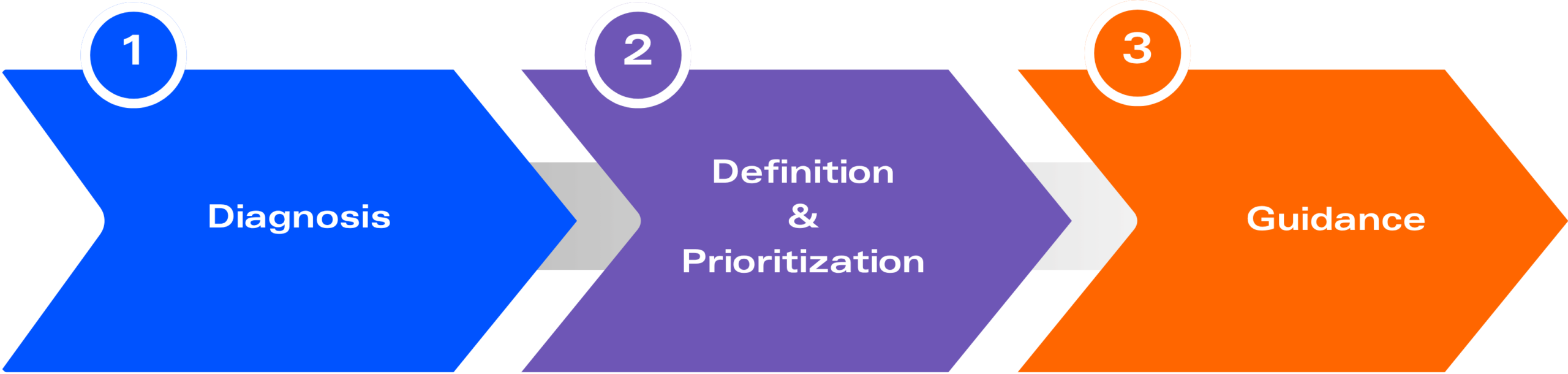
Digital transformation creates sustainable impact when it’s approached as a digital enablement process —governance, capabilities, and operations— rather than isolated technology. We support the organization through all three phases: from diagnosis to execution, adjusting course whenever needed.
Our process

Phase 1: Digital Enablement Diagnosis
- IT Governance Analysis — How digital decisions are made today: who sets priorities, based on what criteria, and how aligned they are with the defined strategy.
- Digital Capabilities Analysis — The extent to which the organization has the real capabilities to execute digital decisions already made, manage complexity, and sustain execution over time.
- Technology Platform and Operations Support Analysis — How current technology support, integrations, and data enable —or limit— day-to-day operations.

Phase 2 — Portfolio Definition and Prioritization
- Translating identified gaps into concrete digital transformation initiatives.
- Building a prioritized portfolio, aligned with strategy and assessed for technical complexity.
- Prioritization based on operational impact, strategic value, and technical feasibility.
- Defining the roadmap.
- Identifying a first high-impact initiative to kick off execution

Phase 3 — Digital Transformation Guidance
Structured Portfolio Tracking — Periodic review of initiative progress, focused on progress, risks, and dependencies, with an executive progress report at each review.
Support on Critical Decisions and Vendor Selection — Support for the leadership team on key decisions during execution.
Impact Monitoring and Recalibration — Tracking of key portfolio indicators, with support for recalibration when needed.
Between 70% and 80% of technology projects fail, either fully or partially, and in AI and advanced analytics initiatives, the failure rate exceeds 95%*
*Standish Group (CHAOS Report, 1994–2015); Gartner (2018–2024); Project Management Institute (2017–2023); IBM (2016–2022); MIT (2025).
Our team
Contact us
Today’s companies require systematic support to build strategic alignment and ensure they remain a source of sustainable value. Implementing not only innovate strategies, but ones that revolutionize the current market and are sustainable in the long term.